STRATEGY LAB FOR INDIAN OPTIONS TRADERS · BACKTEST · PAPER TRADE
 Brovium
, the product Altacee built to let a trader test an options idea before risking money: say the strategy in plain words, see the exact rules it became, backtest it with real costs, check whether it holds, then paper-trade it live.
- CLIENT
- Altacee
- SECTOR
- Trading tools
- PRODUCT
- Brovium strategy lab
- STATUS
- Early access
- STACK
- FastAPI · Python · Angular
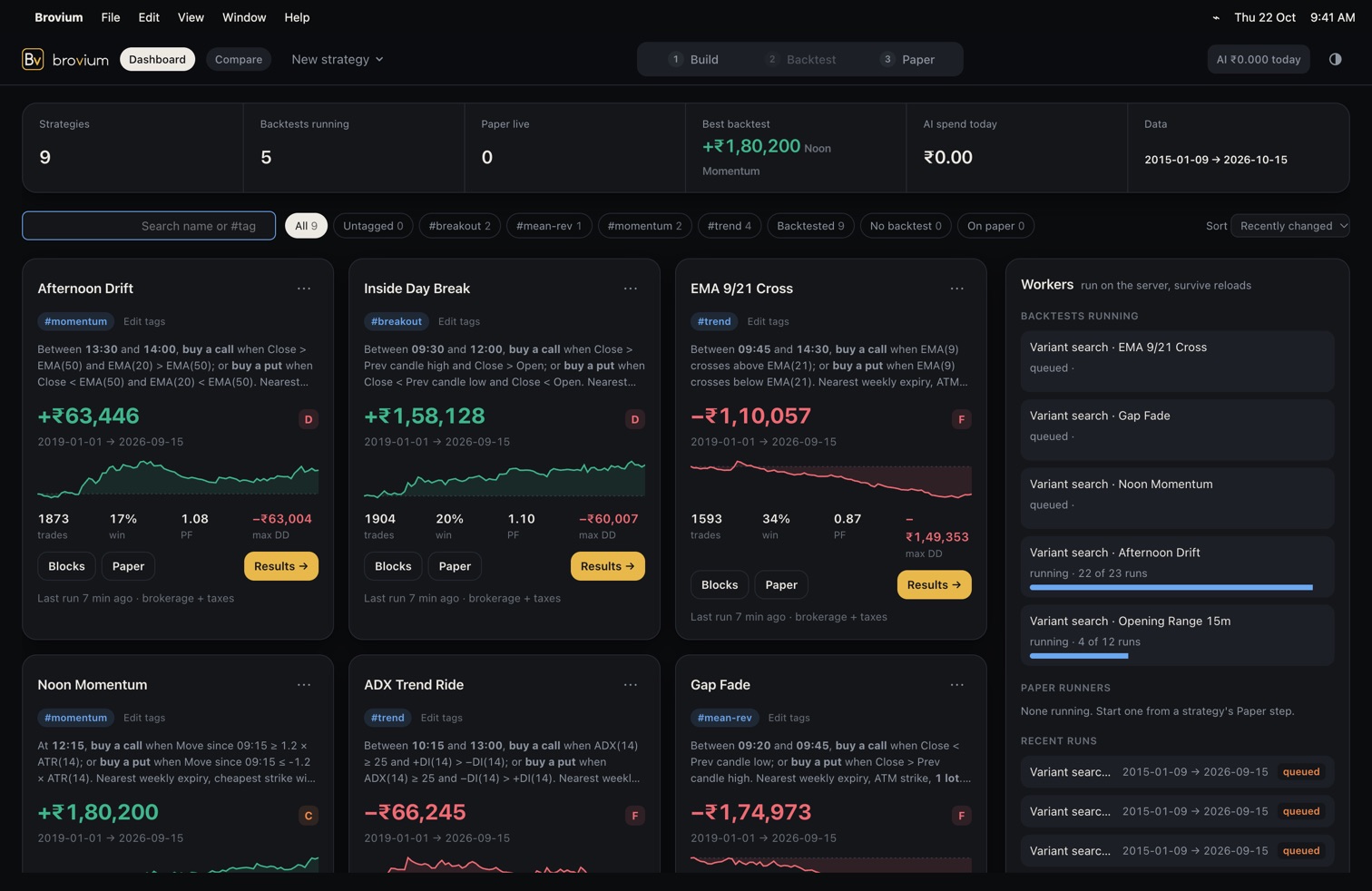 brovium· Strategy dashboard
Test the idea before it costs you
Brovium is a strategy lab for retail traders of NIFTY options. A trader types or speaks a strategy in English, Hindi, Hinglish or Tamil, Brovium turns it into plain rule blocks they can read and edit, backtests it across more than a decade of NIFTY history with brokerage and taxes counted, then runs it as a live paper trade.
Most traders test an idea with real money, because testing it properly means writing code. Brovium removes that step. The strategy is never a black box: every rule the words became is shown as a block, and every trade the backtest took can be opened and read.
Altacee designed and built it end to end: the Python and FastAPI backend with its backtest engine and paper-trading runner, the AI layer that turns speech and text into a strictly typed strategy, the live market-data connections, the dashboard the traders work in, and the early-access site in front of it.
It is a research tool. It does not place real orders and it does not give investment advice; what it gives is an honest answer to “would this have held?” before any money is at stake.
From a sentence to a verdict
Six steps, one product. Each is a working part of the lab.
Say it
- ·Type or speak the strategy in English, Hindi, Hinglish or Tamil
- ·Speech is transcribed, with a fallback for formats such as WhatsApp voice notes
- ·A language model turns it into a typed strategy through a forced tool call on a strict schema
- ·It can only produce rules the engine understands
- ·Long specifications are handled by a stronger model, with retries
See the rules
- ·The strategy appears as plain blocks: entry window, conditions, side, strike, stops and targets
- ·Edit any block by hand; branches and variants are supported
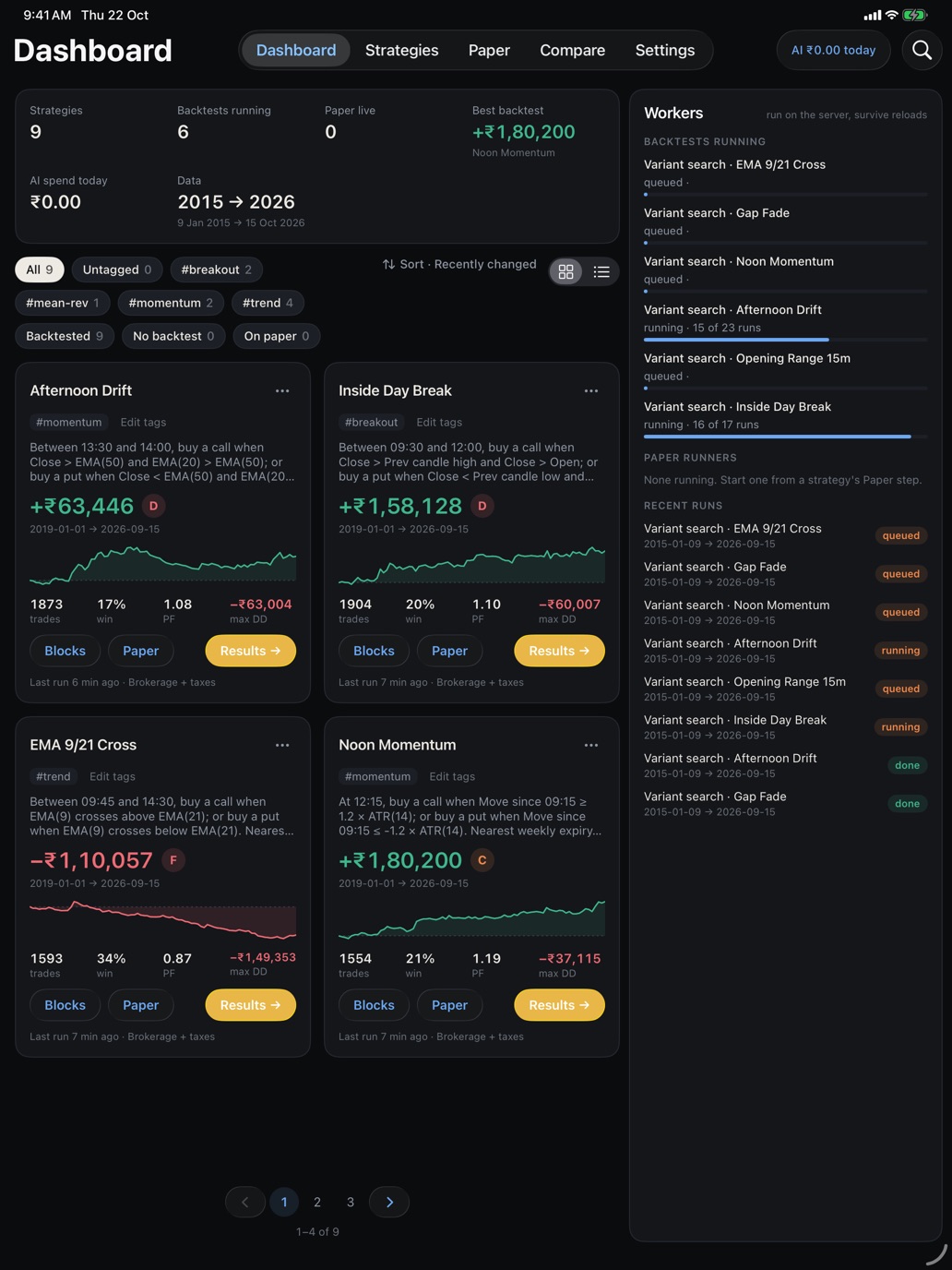
- ·A readable summary sits on every strategy card
- ·Indicators such as EMA, ADX and ATR are available as building blocks
Test it
- ·Backtest on spot candles, with real option prices where the data has them and an estimate where it does not
- ·Every trade is labeled estimate or real
- ·Brokerage and taxes counted, taxes only, or none
- ·Stops and targets by ATR, points, percent or risk-to-reward
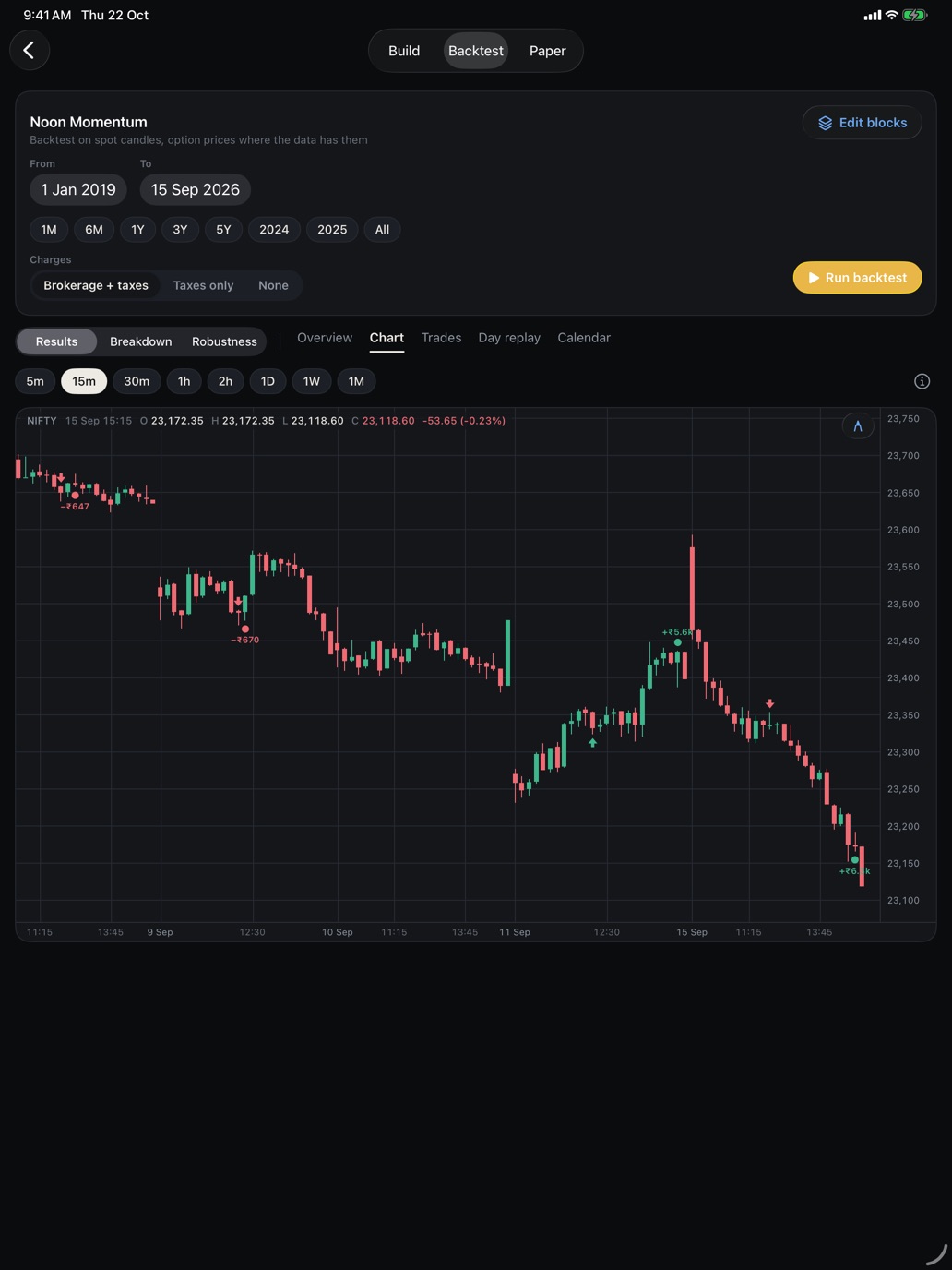
- ·Trades, day replay, calendar and an annotated candlestick chart
Does it hold?
- ·Out-of-sample dates the strategy never saw
- ·Nearby settings, to see whether one lucky value carries the result
- ·A coin-flip rival to beat
- ·Rule removal, to show which rule actually matters
- ·Entry delay, and an AI review that grades the strategy
Paper trade it
- ·A paper runner per strategy, working on live market candles
- ·Runs on the server and survives page reloads
- ·Paper results set against the backtest, side by side
- ·No real orders are placed
Compare and mark up
- ·Put strategies next to each other
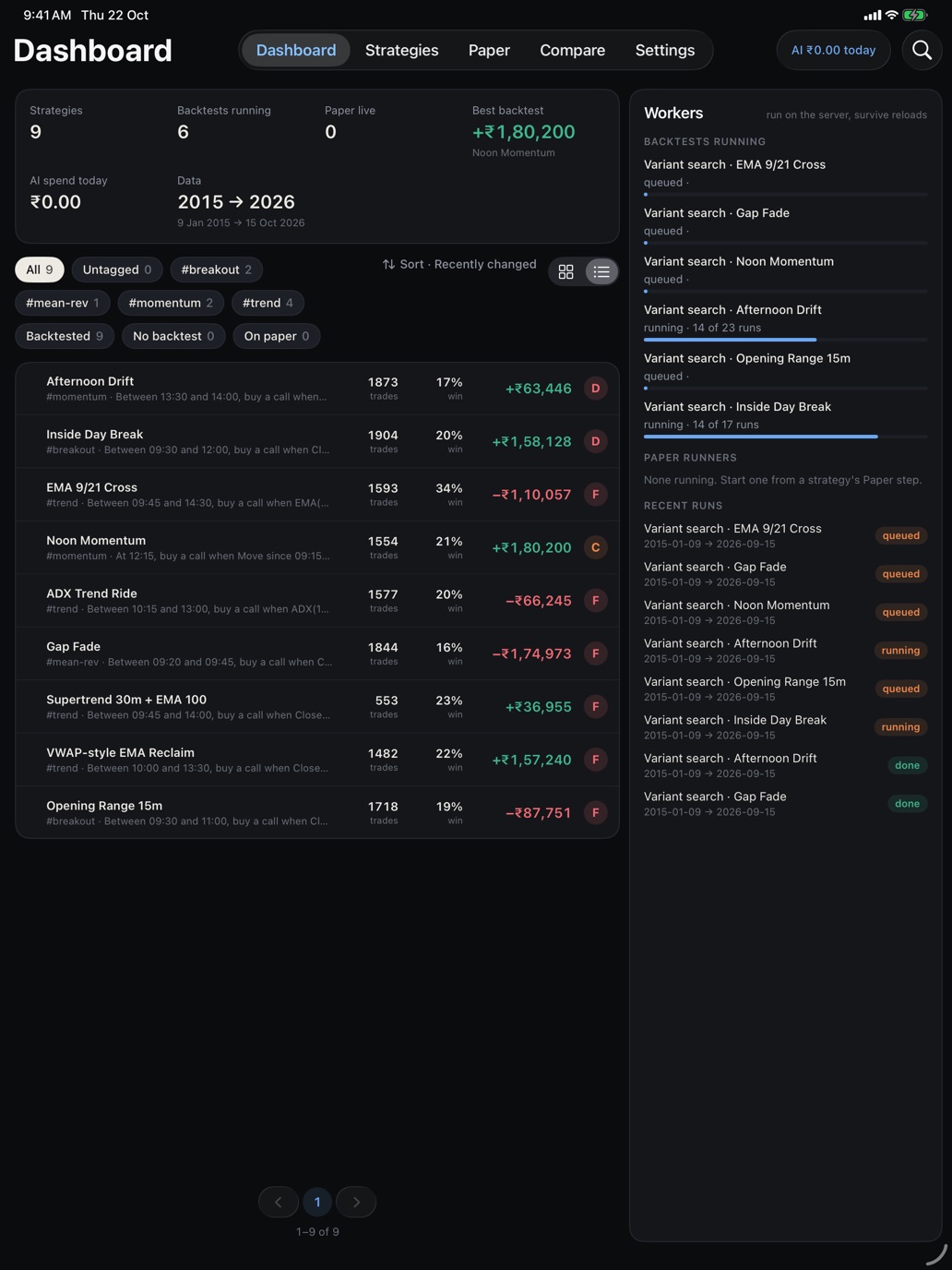
- ·Search, tag and filter a library of strategies
- ·Variant search runs many versions of one idea in the background
- ·Draw on the chart to annotate a trade, with Apple Pencil on iPad
The AI writes rules. The engine does the arithmetic.
The language model never touches a number. It can only hand the engine a strategy in a fixed shape; the backtest, the costs and the checks are ordinary code that can be read and repeated.
- 01Words in: text or voice, in four languages
- 02A forced tool call against a strict schema: typed rules out, nothing else
- 03The engine runs the rules on candles, with costs and an estimate-or-real label on every trade
- 04Five robustness checks, then a paper run to compare against
Between 13:30 and 14:00,
  buy a call when Close > EMA(50) and EMA(20) > EMA(50);
  or buy a put when Close < EMA(50) and EMA(20) < EMA(50).
Nearest weekly expiry.// BUILT TO DISTRUST ITSELF
Why a result can be believed
- Costs counted by default
- Estimate vs real on every trade
- Out-of-sample dates
- Coin-flip rival
- Rule-removal test
- API keys stay on the server
- Paper runs separate from backtests
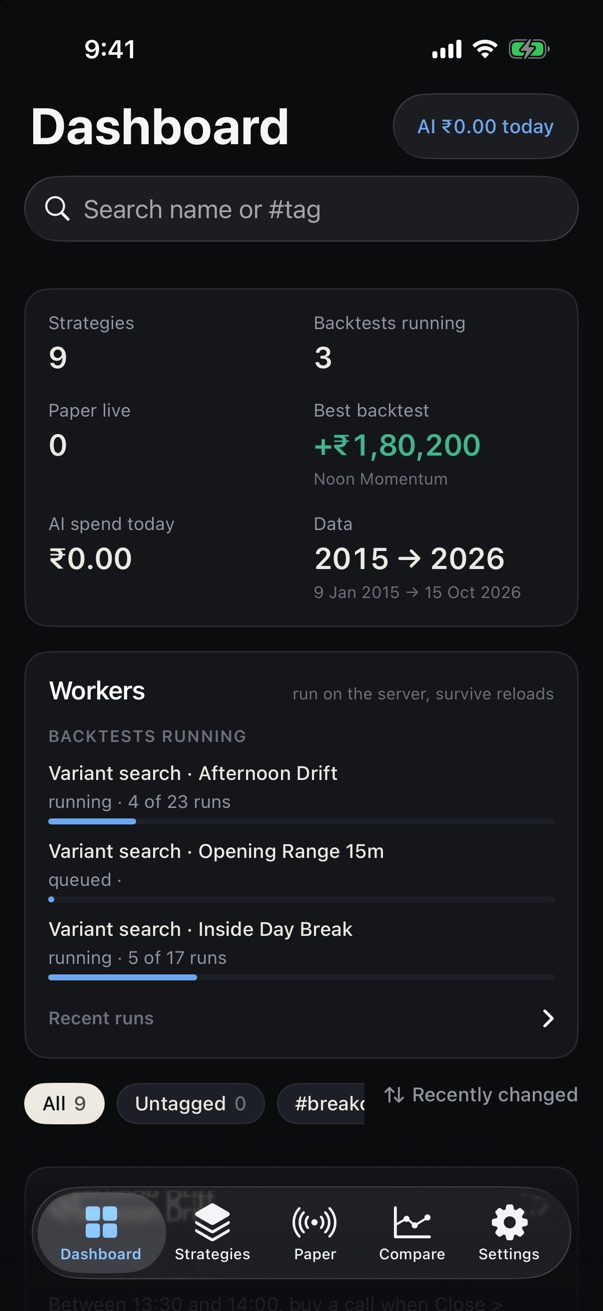
Five screens, as the traders see them
The real interface, shown here with demo strategies.


Brovium, in short
- What is Brovium?
- Brovium is a strategy lab for NIFTY options traders. You say or type a strategy, it becomes readable rule blocks, and Brovium backtests it with real costs, checks whether it holds, and paper-trades it live.
- Who built Brovium?
- Altacee, an AI-native software studio in Lucknow, India, designed and built it end to end: the backend, the backtest engine, the AI layer, the live data connections, the dashboard and the early-access site.
- Which languages can I describe a strategy in?
- English, Hindi, Hinglish and Tamil, by text or by voice.
- Does Brovium place real trades?
- No. It backtests and paper-trades. It places no real orders, and it is a research tool, not investment advice.
- How does it avoid fooling you with a lucky backtest?
- Costs are counted, every trade is labeled estimate or real, and results are tested on dates the strategy never saw, on nearby settings, against a coin-flip rival, with rules removed and with a delayed entry.
- What technology is it built on?
- A Python and FastAPI backend with a backtest engine and paper-trading runner, language models for turning speech and text into strict rule schemas, Zerodha Kite and Groww market data, and an Angular front end on Cloudflare.
> HOW IT SHIPPED
What did Brovium need?
Most retail options traders test an idea with real money, because testing it properly means writing code. Someone with a strategy in their head, in English, Hindi or Tamil, has no way to find out whether it would have held.
How did Altacee build Brovium?
A FastAPI backend turns a typed or spoken strategy into plain rule blocks through a forced tool call against a strict schema, so the model can only emit rules the engine understands. The backtest engine counts real costs, labels every trade as estimated or real, and stress-tests the result against out-of-sample dates, nearby settings and a coin-flip rival. An Angular site sits in front of it.
What did Brovium get?
A trader can say a strategy, see every rule it was turned into, backtest it, check whether it holds, then paper-trade it live before risking money. In early access; a research tool, not investment advice.
Want a system like this?
Tell us what you're building. We'll respond with a scoped plan, not a sales pitch.